

The Medical Billing Process Flowchart: A Visual Guide
- September 28 2026

Table of Contents
The medical billing process is the workflow that turns documented healthcare services into submitted claims, payments, and resolved balances. The process begins with documentation of the services provided and continues through claim payment and resolution of any remaining insurance or patient balance.
This guide presents 10 steps in the medical billing cycle, from clinical documentation through patient billing and collections. Each step depends on the one before it, and a breakdown at any point can delay payment or create a denial.
How Does the Medical Billing Process Work?
Each step represents one of the significant components of the medical billing workflow, building on earlier information as the account moves toward claim payment and balance resolution.
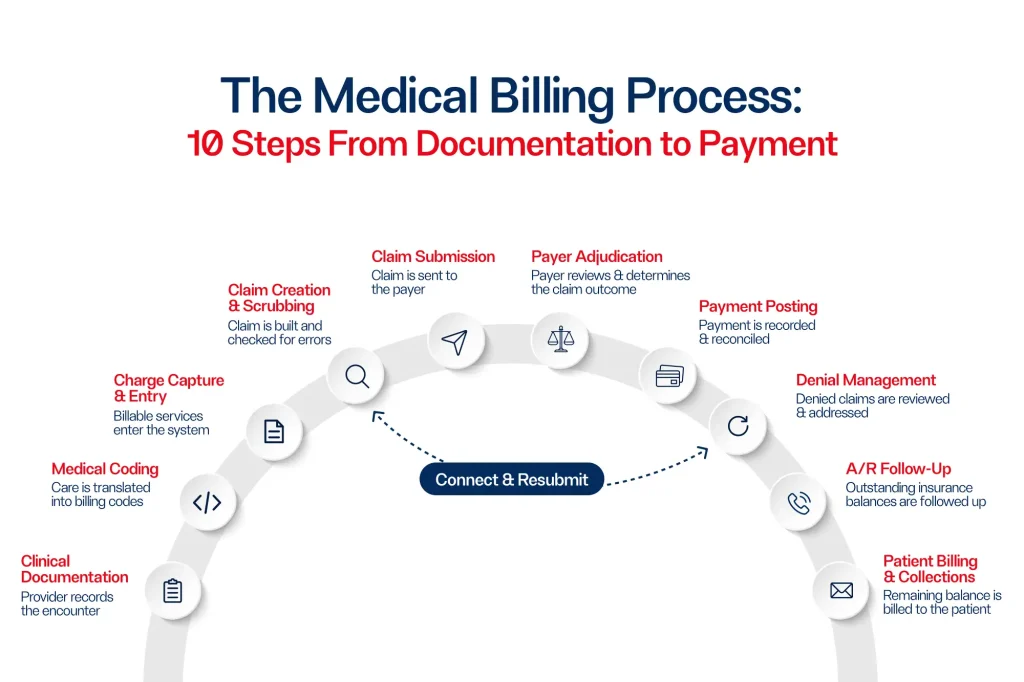
1. Clinical Documentation
Several recurring tasks compete for the same front-desk capacity in a dental practice on any given day:
The provider records the diagnoses, procedures, and clinical details of the encounter. This documentation becomes the source information used for coding, billing, and claim preparation.
Key considerations:
- Documentation should reflect the services actually provided
- Clinical details should support the reported diagnoses and procedures
- Complete documentation gives coders the information needed to assign accurate codes
2. Medical Coding
Coders review the clinical documentation and assign the diagnosis and procedure codes that represent the documented services and conditions. These codes become part of the information used to process the claim.
Key considerations:
- Codes should match the services and conditions documented in the medical record
- Coding should reflect the appropriate level of specificity supported by the documentation
- Coding errors can affect claim processing and reimbursement
3. Charge Capture and Entry
The billing team identifies the billable services from the encounter and enters the corresponding charges and details into the practice’s billing system.
Key considerations:
- Billable services should be captured before the claim is created
- Charge details should align with the documented services and assigned codes
- Missing or delayed charges can postpone claim submission
4. Claim Creation and Scrubbing
The billing system combines patient, provider, insurance, coding, and charge information to create the claim. Before submission, the claim is checked for missing, inconsistent, or potentially incorrect information.
Common pre-submission checks include:
- Verifying patient and insurance information
- Checking diagnosis and procedure codes for consistency
- Reviewing modifiers and required claim fields
- Identifying potential formatting or data errors
Claim scrubbing can help identify avoidable errors before submission, but it does not guarantee that a claim will be paid.
5. Claim Submission
The completed claim is transmitted to the appropriate payer, usually through an electronic clearinghouse. The billing team tracks the submission to confirm that the claim was received and can move through payer processing.
Key considerations:
- Electronic submission is commonly used for medical claims
- Submission confirmation can help identify transmission problems
- Claim submission does not mean the payer has approved or paid the claim
6. Payer Adjudication
The payer reviews the submitted claim against its coverage and payment rules and determines how the claim will be processed.
Outcome | What It Means |
Paid/Processed | The claim is processed for payment |
Rejected | The claim is not accepted for processing and may require correction |
Denied | The claim is adjudicated, but payment is not allowed as submitted |
Payer rules and processing times vary, so the outcome and timing can differ based on the payer and claim.
7. Payment Posting
The billing team records payer payments and adjustments using the explanation of benefits (EOB) or electronic remittance advice (ERA). Payment posting follows payer adjudication and records the payment outcome on the patient account.
Key considerations:
- Payments and applicable adjustments should be posted accurately
- Patient responsibility should be recorded after insurance processing
- Payment discrepancies may require additional account review
8. Denial Management
The billing team reviews denied claims, identifies the reason for nonpayment, and determines the appropriate response, which may include correcting the claim, resubmitting it, or filing an appeal.
Common actions include:
- Reviewing the payer's denial reason
- Correcting claim information when needed
- Gathering supporting documentation when required
- Resubmitting the claim or filing an appeal
Effective denial management helps address unpaid claims before they remain unresolved.
9. A/R Follow-Up
The billing team monitors outstanding insurance balances and follows up with payers on claims that remain unpaid or unresolved after submission or adjudication.
Key considerations:
- Track outstanding claims according to payer and account timelines
- Document payer responses and required next actions
- Follow up on claims that remain unresolved
- Continue account activity until the outstanding insurance balance reaches an appropriate resolution
10. Patient Billing and Collections
After insurance processing is complete, the medical billing collection process steps begin with billing any remaining patient responsibility and following up on the outstanding balance according to the practice’s billing and collection procedures.
Key considerations:
- Patient statements should reflect insurance payments and applicable adjustments
- Patient balances should be tracked separately from insurance A/R
- Follow-up may include payment reminders or available payment arrangements
Medical Billing vs. Revenue Cycle Management
Medical billing focuses on preparing, submitting, and resolving claims, while revenue cycle management (RCM) covers the broader financial workflow surrounding patient care, from earlier front-end activities through final payment.
Medical billing is one component of RCM, not a separate or competing process. The table below outlines how the two terms differ in scope.
Aspect | Medical Billing | Revenue Cycle Management |
Scope | Billing and reimbursement | End-to-end financial workflow |
Primary Focus | Claims and related balances | Overall revenue cycle |
Typical Activities | Coding, charges, claims, payments, denials, A/R | Registration, eligibility, authorization, billing, payments, A/R |
Main Objective | Support claim payment | Manage financial performance |
Relationship | Part of RCM | Includes billing and other revenue functions |
Organizations do not always define the exact boundaries of their revenue cycle in the same way, so these categories can shift slightly depending on how a practice structures its operations.
What Has Changed in the Medical Billing Process in 2026?
Medical billing in 2026 is being shaped by changes to prior authorization, Medicare payments, coding, and claim review. The following updates have the most direct impact on medical billing workflows in 2026.
Electronic Prior Authorization Requirements
CMS’s 2026 prior authorization requirements include shorter decision timeframes and specific reasons for denied requests. This means billing teams may receive authorization decisions sooner and have clearer information when a request is denied.
For billing teams, the key is to track authorization status and payer decisions carefully before claim submission. Confirming that required authorization is in place can help prevent claims from being submitted without the necessary approval.
Medicare Payment Updates
CMS’s 2026 Physician Fee Schedule changed Medicare payment amounts for applicable services, including updates that affect how certain services are reimbursed. These changes can affect the amount a practice expects to receive from Medicare.
For billing teams, the important point is to use the applicable 2026 payment amounts when estimating Medicare reimbursement and reviewing payments. This helps identify differences between expected and actual Medicare payments during payment posting and reconciliation.
New ICD-10-PCS Codes
CMS added 80 new ICD-10-PCS codes effective April 1, 2026, including codes for procedures involving intestinal inspection, intestinal device insertion, and other new technology procedures. These additions give facilities more specific codes for reporting affected inpatient procedures.
When these procedures are performed, the procedure documented in the medical record should align with the applicable 2026 ICD-10-PCS code reported on the claim. Using the updated code set helps ensure the procedure is represented accurately during billing.
AI-Supported Claim Review
CMS launched the WISeR Model in 2026, using artificial intelligence and machine learning alongside human clinical review for selected Original Medicare services in six states. For certain services, claims can receive additional review of coverage, documentation, coding, and payment requirements before payment.
For billing teams handling affected services, this makes complete documentation, accurate coding, and correct claim information especially important. Checking these details before submission can help ensure the claim is ready for the additional review process.
We Keep Your Medical Billing Workflow Moving With Reliable Virtual Support
Conclusion
The medical billing process follows a clear path. It starts with clinical documentation and coding, moves through claim submission and payment, and ends with any denials, follow-up, or patient billing that still need attention. When each step gets accurate information, claims move forward more smoothly.
2026 brings a few things worth keeping an eye on. Prior authorization rules have shifted, Medicare payments have updated, new codes are in place, and AI now plays a bigger role in reviewing claims. Knowing how the full process fits together makes it easier to spot where a billing team might need a closer look or a little extra support.
Frequently Asked Questions
A medical claim typically requires patient and insurance details, provider information, dates of service, diagnosis and procedure codes, charges, and other payer-required information.
Providers document care, coders assign codes, billers prepare and submit claims, clearinghouses transmit electronic claims, and payers adjudicate claims and determine payment outcomes.
Yes. Medical billing workflows can vary by specialty, payer, claim type, and service because coding, authorization, documentation, and payment requirements may differ.
Common medical billing documents include clinical records, insurance information, claims, electronic remittance advice, explanations of benefits, patient statements, and supporting documentation when required.
Data should be entered accurately and consistently, with patient, service, charge, coding, and insurance details matching the underlying medical record.

Dr. Shane Wilson
Table of Contents


- Follow Us
Let our experts handle scheduling, calls, documentation, and paperwork 24/7